
Buy on Amazon
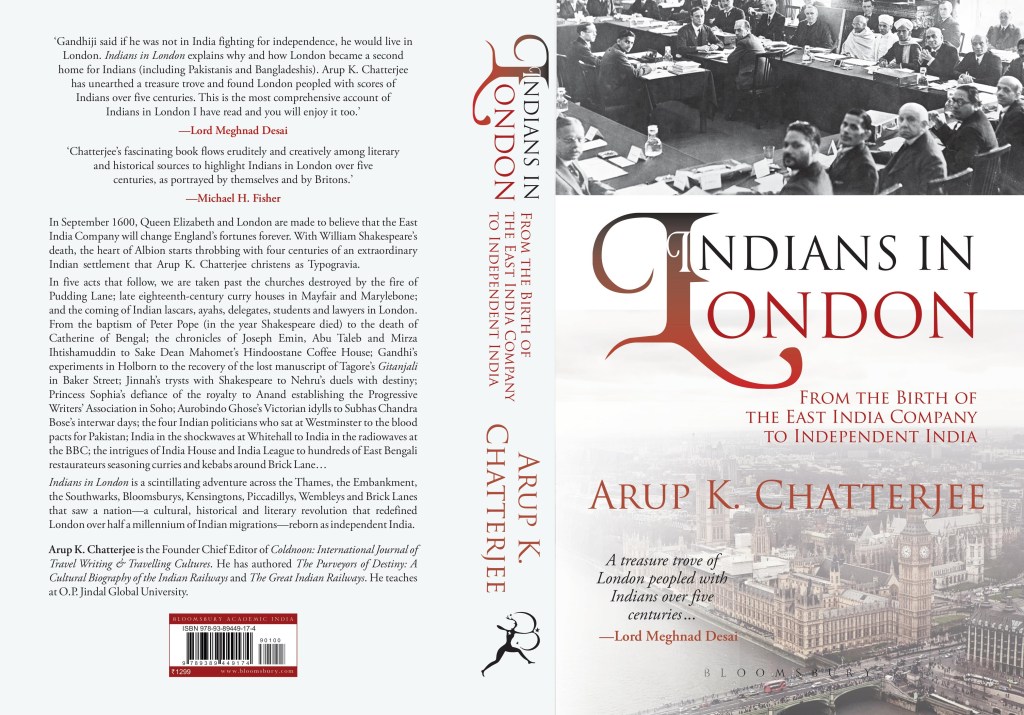
Indians in London: From the Birth of the East India Company to Independent India (Bloomsbury 2021)
Critical Acclaim

‘Indians in London explains why and how London became a second home for Indians (including Pakistanis and Bangladeshis). Arup K. Chatterjee has unearthed a treasure trove and found London peopled with scores of Indians over five centuries. This is the most comprehensive account of Indians in London I have read and you will enjoy it too.’
Lord Meghnad Desai
‘Arup K. Chatterjee’s fascinating book flows eruditely and creatively to highlight Indians in London over five centuries … A scintillating book … [on] diverse Indians of all classes [who] were not necessarily always acted upon, but had their own agency, their own attitudes, and their own actions. The book extends Indian history to Britain, greatly adding to works that provincialize Europe.’
Michael H. Fisher

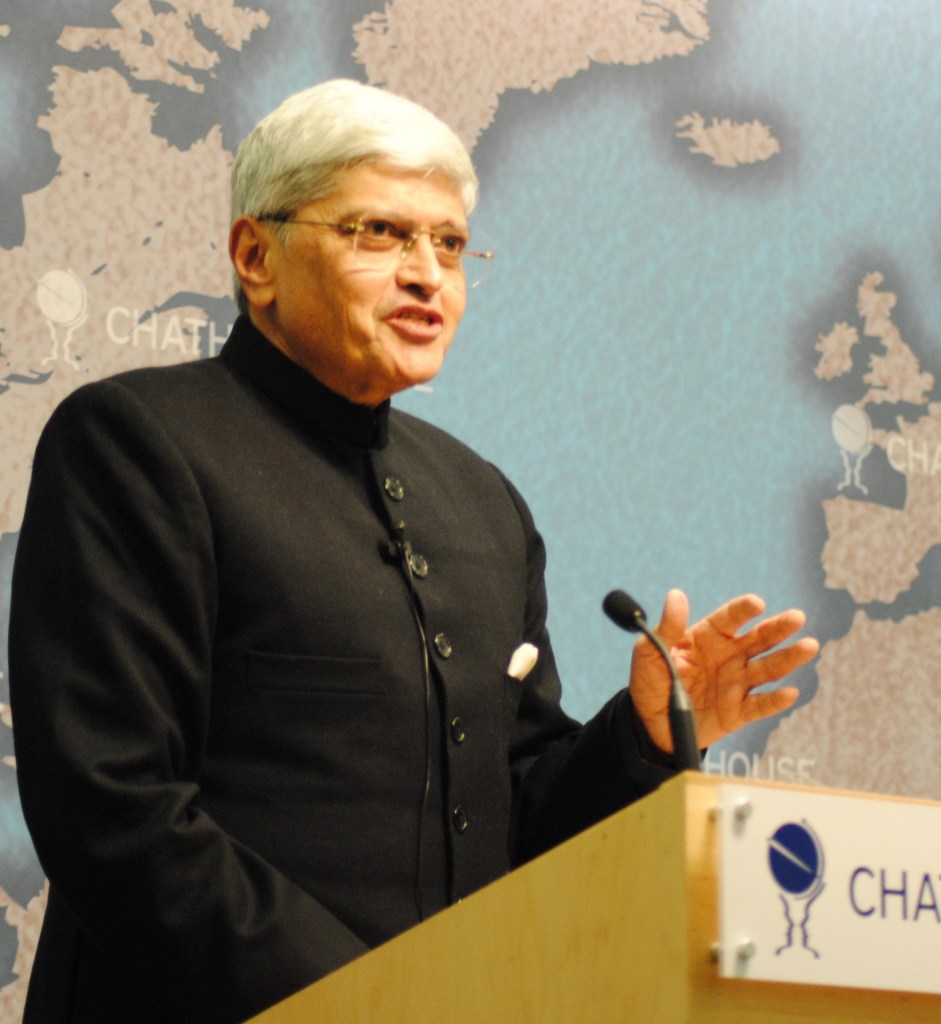
‘A fascinating book, written with immediacy … but without a voyeuristic intimacy. [Arup-babu] has tried to unravel stories, without sensationalizing them, with sympathy and respect for [his characters] even when he is lethally critical of them …There is no slant in it. It has the royalty, the subalterns, the rich, and absolutely down-and-outers … It has Indians in all their varieties, all their contradictions, all their contrasts, conflicted as they are … but Indians [nevertheless] …’
Gopal Krishna Gandhi
‘A remarkable achievement of 500 pages, packed with gems, remarkable memories wonderful vignettes, terrific anecdotes, drawn so widely, both historically and in terms of themes … [that] become a brook, a stream and a veritable tributary … a very timely book, given the prominence of Indians in British society today … Indians in London adds texture to the colonial relationship between Britain and India, by unravelling the complexity of its various strands, particularly through intimate descriptions of individuals that lie below.’
Paul Flather

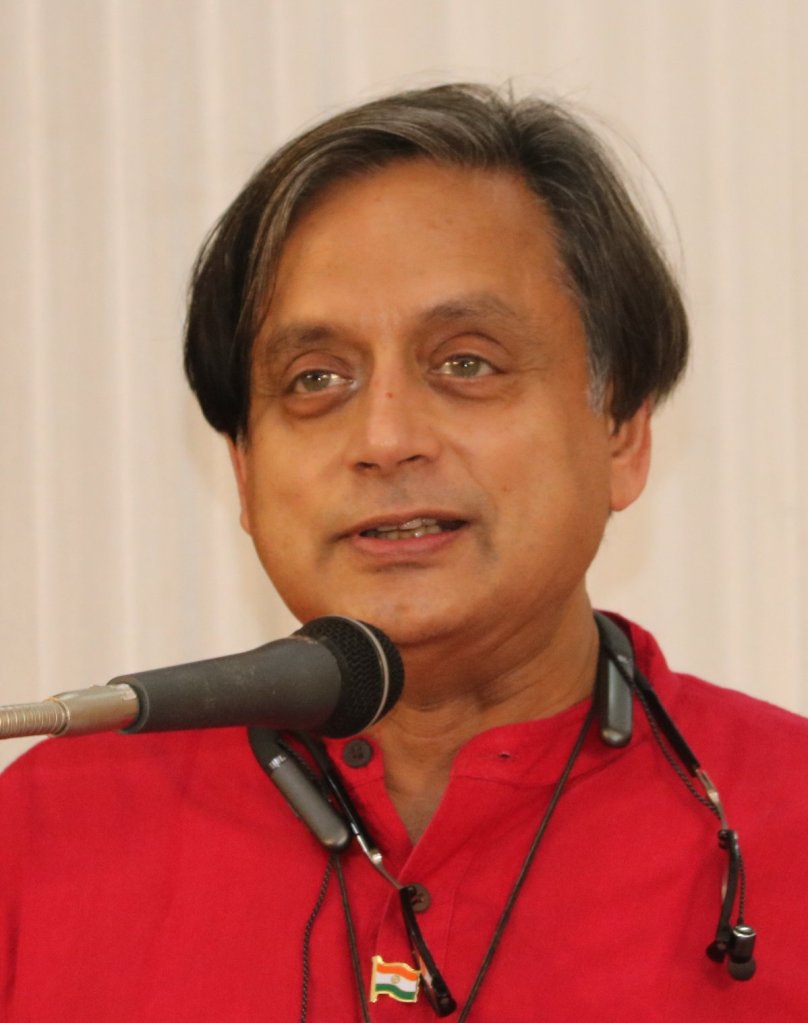
‘A delightful work that covers a vast amount of ground in its 500 pages, full of detailed research, which wears its erudition … [nonetheless] amazingly readable.’
Shashi Tharoor
‘There is a rich history of the migration, both short- and long-term, of Indians to London from at least the early seventeenth century … Arup K. Chatterjee’s new book … opens up this rich, varied history and aims to reach a wide audience … a comprehensive overview of the key figures and groups who populated the city from the early seventeenth century until 1947 … in a new format and furnished with an interesting literary style that will fascinate international audiences of general readers.’
Sumita Mukherjee, in The English Historical Review


‘Indians in London is a riveting narrative that investigates the lives and experiences of numerous Indians who visited, stayed, and left their mark in the imperial capital of London from around the time of Shakespeare to Indian independence in 1947 … Chatterjee has divided the book into five acts and scenes by replicating the structure of a Shakespearean play, through which he reveals the Indian psyche that clung to the idea of London.’
Md Sarfaraj Nawab in The European Legacy
‘It’s a rare book which may be described unequivocally as an absolute and utter delight. This is one of them. Arup K. Chatterjee’s Indians in London is an erudite, well-researched and comprehensive survey of a fascinating subject—four hundred years of Indian residency in London, beginning in 1600. This was the date that the East India Company was founded, but also the year when Shakespeare’s As You Like It was entered in the Stationer’s Register.
‘The latter is as important for this book as the former; Chatterjee imaginatively uses the five-act structure of an Elizabethan play as his framework in lieu of chapter headings, showing how people from the Indian subcontinent (Chatterjee includes those who would now be Pakistanis and Bangladeshis in his book) progressed from being a few exotic foreigners in Act I to members of a significant part of the beating heart of modern cosmopolitan London. There are entrepreneurs, politicians, lawyers, students, nursemaids, poets, novelists, the inevitable restaurateurs and even the odd princess, not to mention a sprinkling of dubious characters as well in this play, with a cast of thousands all playing their parts in the still-unfolding drama. Famous names abound, too; at one time Gandhi, Rabindranath Tagore, Subhas Chandra Bose, Princess Sophia Duleep Singh, Swami Vivekananda, Jiddu Krishnamurti, Mohammed Ali Jinnah and Jawaharlal Nehru, to name but a few, all lived in London and made their marks there. You can even find out exactly where all these people and many others lived in London by consulting the helpful map and its key (list of names) at the beginning of the book.
‘The scope of characters discussed in Chatterjee’s book is monumentally wide (as is the massive bibliography); a reviewer must be restricted to mentioning those parts which are personally interesting. There is, in fact, a character for every taste from food to politics in this book. A great deal of space is devoted to food and restaurants, which are, after all, perhaps the two aspects of Indian culture best known to foreigners. In London alone there must be at least a thousand or more Indian restaurants after allowing for Covid- and Brexit-induced closures; even in Winnipeg, where I live, there are still at least thirty … Chatterjee gives us so much detail and presents so many fascinating characters from this period that it’s impossible to sum it all up in a review; suffice it to say here that readers become immersed in the teeming cast of thousands in this play, which reads is more like a Hollywood epic (with lots of extras) than a Shakespeare play with a few characters! … Chatterjee’s exciting book is a triumph of scholarship and a wide-ranging adventure leading us to come to a greater understanding of the evolution of one of the world’s most historically cosmopolitan cities.’
(John Butler, former Associate Professor of Humanities at the University College of the North in The Pas, Manitoba, Canada; in the Asian Review of Books)
 Arup K. Chatterjee