
Buy on Amazon
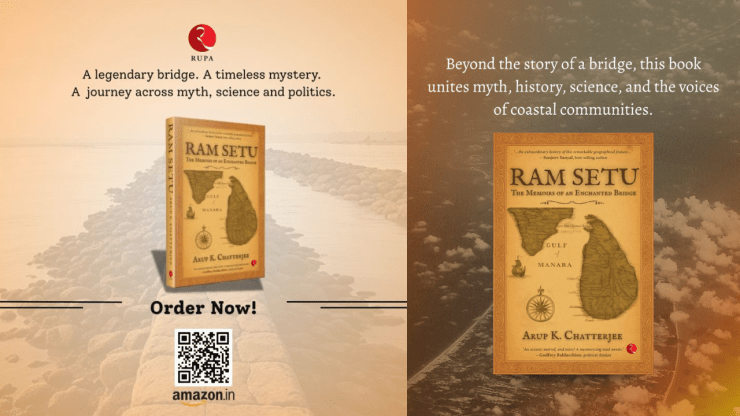
Ram Setu: The Memoirs of an Enchanted Bridge (Rupa 2024)
Critical Acclaim
‘The sliver that connects the southern tip of India to the northern tip of Sri Lanka, Ram Setu—or Rama’s Bridge—is part of the childhood imagination of every Hindu. In this scholarly work, writer Arup K. Chatterjee looks at how the legend, local history and geological reality come together on the ground. Digging meticulously through old maps and forgotten stories, he pieces together the extraordinary history of this remarkable geographical feature.’
Sanjeev Sanyal
‘We all love a good story. Especially when it enthralls multiple audiences in different ways. In Ram Setu, now in its Indian edition, gifted raconteur Arup K. Chatterjee guides us through the many representations of this singular formation: at once majestic in its geology and profound in its symbolism. It lies poised gracefully yet precariously between two nations, land and sea, sacred and secular, tranquillity and turbulence. Here is a rare terraqueous ecosystem of 103 reefs and sandbanks, where islets emerge at low tide. Once an unbroken causeway; shattered by a violent tropical storm in 1480; then the site of the thriving port city of Dhanushkodi; abandoned after another catastrophic storm in 1964 claimed some 1,800 lives. It is a sacred space, a divine work of art and science, and a long-neglected link between Tamil Nadu/India and Sri Lanka. Is it not the legendary land bridge built by a monkey army so that their master could rescue his wife from a demon-king? For the countless species that inhabit its waters and shores, it is home. An oceanic marvel, and more! A mesmerizing read awaits…’
Professor (Dr) Godfrey Baldacchino

‘In Ram Setu, Arup K. Chatterjee offers a deeply researched sociocultural exploration of one of the Indian Ocean’s most intriguing geological formations—a chain of coralline ridges stretching between Pamban Island on India’s southeastern coast and Mannar Island on the northern coast of Sri Lanka. Revered in Hindu legends as the bridge built by Ram’s army, this formation has long been a focus of both spiritual devotion and scientific curiosity. Chatterjee’s study navigates the intertwined realms of ethnography, historiography and environmental justice, offering novel perspectives on how this remarkable structure might be safeguarded as part of India’s shared heritage with Indian Ocean territories, through meaningful cross-cultural collaborations. This is a richly insightful and compelling work—an essential read for anyone interested in the confluence of nature, nurture, culture and belief.’
Professor (Dr) CP Rajendran
‘In Ram Setu: The Memoirs of an Enchanted Bridge, Arup Chatterjee undertakes an exquisite, evocative and entertaining multidisciplinary journey through time, legend and geopolitics to unravel one of India’s most storied and contested sites. From Valmiki’s verses to colonial cartographies, courtroom proceedings, satellite imagery, and whispered conversations among coastal fishermen, Ram Setu emerges as more than stone or story—it is a geological marvel, a civilizational Polaris, a threshold where ‘eons of suppressed memories collide with spectacular intensity’. Engrossing and inventive—at times shimmering with the texture of magical realism— Chatterjee offers not just the beguiling tale of a bridge, but a sublime meditation on belief, belonging, and the haunted architectures of Indian modernity.’
Professor (Dr) Ashwani Kumar
‘Ram Setu offers a rich and layered examination of the historiography surrounding this remarkable formation. Drawing together mythic traditions, literary representations, colonial-era accounts, and present-day political debates, Arup K. Chatterjee illuminates how this geographical feature has acquired such a commanding place in the cultural imagination. The study makes clear that much of the debate around Ram Setu is as much about geology as about its symbolism and public spectacle—what Clifford Geertz, the eminent anthropologist, might have described as ‘theatre’ in the shaping and reshaping of sacred geographies of India and India’s historical expanse as far as up to Southeast Asia.’
Professor (Dr) Subhash Kak
‘Blending the sacred traditions surrounding Ram Setu with its geoscientific understanding, Arup K. Chatterjee presents a compelling narrative of the tombolo that links India and Sri Lanka. Interweaving stories of origins, politics, diplomacy, ecology, and the urgent dilemmas of the Anthropocene, the book speaks directly to current debates over dredging the area. What are the potential risks and rewards for both people and the planet? How do age-old beliefs intersect with the forces of modern commerce? Marked by scrupulous scholarship and cultural insight, Ram Setu stands out as a work of lasting relevance and engaging storytelling.’
Professor (Dr) Malashri Lal

‘An aerial view of Ram Setu (or Adam’s Bridge) reveals a stunningly beautiful strip of shallow limestone shoals in an emerald-blue sea with wispy clouds hanging low in the sky. It is, as this book’s author calls it, indeed an enchanting bridge, just 30 miles long, connecting India and Sri Lanka. Richly redolent in epic lore, centuries of cultural memory, it presents a fascinating, if contentious, legacy, from colonial times through India’s independence to the present. Professor Arup K. Chatterjee’s richly textured account of Ram Setu, as story and symbol, legend and history, politics and commerce, is indeed a treat. His fascinating narrative is, however, tantalizingly restrained, if not deliberately diplomatic, when it comes to any definitive interpretation as regards its meaning or significance. That is how it should be. For with its meticulous, even unparalleled, research, this readerly exegesis invites us to draw our own conclusions. An absorbing and compelling chronicle; highly recommended.’
Professor (Dr) Makarand R. Paranjape
‘For centuries, the chain of shoals stretching between India and Sri Lanka has shimmered in the twilight between faith and fact. Known to some as Ram Setu and to others as Adam’s Bridge, it has been imagined as both divine architecture and coral geology. In this book, Arup K. Chatterjee returns to this contested site — not to settle the debate but to reveal how its mystery has always been inseparable from the stories told about it. Chatterjee’s strength lies in his ability to braid together myth, history, geology, and politics without letting any strand fray. Drawing on the Ramayana, colonial surveys, satellite imagery, and contemporary environmental movements, he shows how Ram Setu has been remade in every era: by scholars who named it “Adam’s Bridge” to fit Islamic cosmology, by leaders who reclaimed it as a symbol of Hindu faith, and by climate activists who see it as a fragile marine ecosystem. The bridge, in his telling, is less a structure than a palimpsest of human longing and belief. The narrative flows like the tides it describes — sometimes gently reflective, sometimes charged with the cross-currents of politics. Chatterjee gives equal space to mythical figures, colonial explorers, archaeologists, and the coastal communities that live in the shadow of the Setu. This pluralism is refreshing. In lesser hands, Ram Setu might have remained a spectacle of legend or litigation. Here, it becomes a living geography where devotion, livelihood, and identity converge. He studies the site neither just as 48 kilometres of shoals nor as just an idea, but as a unified ecosystem — a chain of reefs and sandbanks that once formed an unbroken causeway, later broken by storms and shifting seas. By grounding the narrative in geological time, Chatterjee shows how even nature carries traces of human belief … What makes Ram Setucompelling is its refusal to choose between reverence and reason. It neither debunks nor defends myths. Instead, it asks why this sliver of land continues to matter so deeply to Indians. The answer, Chatterjee suggests, lies in our need to find meaning in geography — to see, in the shifting sands of the Setu, a reflection of our own questions about faith, nationhood, and the environment. The book achieves what few works on heritage do: it transforms a polarising controversy into a study on coexistence. Ram Setu is at once travelogue and testimony, science writing and cultural history. It reminds us that bridges — whether built of coral or conviction — connect more than they divide.’
Aditya Prasanna Bhattacharya, in The Telegraph, India
‘Imagine a bridge that is not merely stone and coral but a living witness to three millennia of faith, politics, science, poetry, and conspiracy, and that is precisely what Arup K Chatterjee achieves in this daring, genre-bending work, allowing the Ram Setu itself to speak the story of its own existence. Written in the first person as the memoirs of the bridge (yes, the 48-kilometre chain of limestone shoals between India and Sri Lanka narrates its own autobiography), the book is part literary experiment, part historical excavation, and part philosophical meditation. The voice Chatterjee crafts for the Setu is ancient yet wry, devout yet sceptical, wounded yet indestructible. It remembers that an army of monkeys under Nala and Nila built it, Tamil Sangam poets sang of its beauty, nineteenth-century British surveyors called it ‘Adam’s Bridge’, and dynamite-wielding engineers sought to blast it open for a shipping canal, which makes it quietly rage. The narrative moves fluidly across registers. One moment, the Setu is recounting the churning grief of Sita walking across it barefoot after her rescue; the next, it is dissecting NASA satellite images and geological papers with the cool detachment of a retired professor. Chatterjee has studded the book with references to the Valmiki Ramayana, Kalidasa, the Rajatarangini, Portuguese chronicles, Madras Presidency gazetteers, and modern oceanography, yet he ensures it never feels like an academic tome. Instead, it reads like an impossibly erudite bedtime story told by a bridge that has seen everything and is slightly tired of human nonsense. Some of the most unforgettable passages are when the Setu turns ironic. It mocks the 2007 affidavit that denied its man-made origin, then gently forgives the politicians who withdrew it. It laughs at treasure hunters who dove for Hanuman’s lost jewels, and it ribs both the devout who want it declared a national heritage monument and the rationalists who insist it is nothing but a natural tombolo. In one delicious chapter titled ‘I Have Been Cancelled Before It Was Fashionable’, the bridge lists how governments, courts, and activists repeatedly tried to erase, rename, or blow it up. Chatterjee’s prose is lush without being purple. Sentences glide like waves over coral, “I have carried the footsteps of gods and smugglers, pilgrims and marine biologists, lovers who believed the tide would hide their kisses and soldiers who planted landmines where once vanaras placed stones.” At just under 280 pages, the book is mercifully concise, yet it leaves you feeling you have travelled across centuries … the enchanted tone occasionally flirts with preciousness; a few readers might find the bridge’s self-pity when discussing modern pollution or the Sethusamudram project a touch overwrought. But that is a small price to pay for a work this original. Ram Setu: The Memoirs of an Enchanted Bridge is that rare book that can sit comfortably on the shelf next to Amitav Ghosh’s Ibis trilogy and Roberto Calasso’s mythological retellings. It will delight mythology lovers, irritate ideologues on both sides of the rationalist–devotional divide, and quietly enchant anyone who has ever stood on the shores of Dhanushkodi and felt something older than history stirring in the wind.’
Vishal Tiwari, in Bharat Express
‘Arup K. Chatterjee in Ram Setu: The Memoirs of an Enchanted Bridge takes the reader on a multidisciplinary journey that combines scientific, historical, sacred, and symbolic discourses on this contentious causeway. Taking on the monumental task of piecing together the remarkable story of the Ram Setu bridge that connects the southernmost and northernmost tips of India and Sri Lanka, respectively, Arup K. Chatterjee in Ram Setu: The Memoirs of an Enchanted Bridge takes the reader on a multidisciplinary journey that combines scientific, historical, sacred, and symbolic discourses on this contentious causeway. The book attempts to answer a simple question: Was Ram Setu, first described in Valmiki’s Ramayana, built by Lord Rama and his Vanara allies, or is it one of those mysterious and miraculous creations attributed to Mother Nature? Like all truly good questions, it leads only to more questions of increasing perplexity rather than providing a conclusive answer, which is just as it should be. According to legend, the bridge was designed by Nala, believed to be the offspring of Vishwakarma, and built by King Sugriva’s Vanara army so that Rama could cross the sea and rescue his wife, Sita, who had been kidnapped by Ravana. Drawing on Valmiki’s immortal verses, colonial history, politics, court proceedings, satellite imagery, documentaries, and ecological concerns, Chatterjee attempts to lay bare the heart of the matter with penetrating insights. To date, there is no consensus on whether the blessed bridge is natural or created by human intervention. Scientific evidence exists in favour of both viewpoints. Conflicting theories abound about the bridge’s supernatural properties. It was first raised in the Treta yuga by divine intervention and, some believe, continues to be a benevolent protector of humankind — fitting for a gift of Rama, Vishnu’s avatar. Chatterjee also addresses the concerns of poor Tamil fisherfolk. They have been sacrificial pawns in the political one-upmanship between India and Sri Lanka. Many have faced ruinous fines, imprisonment, and even death at the hands of the Lankan navy. As he writes, the Palk Bay conflict “had turned the Sethusamudram region into the killing waters of the Indian Ocean.” The book also turns to the dilemmas of the Anthropocene. Chatterjee raises concerns about aggressive coral harvesting and calls for reconstruction of the coralline bed. He points to islands like Tuticorin’s Vaan Island in need of revival. “A major finding from the Vaan experience is that the reduction of human interference in the environment can control macro- and meso-plastic pollutants and refine the quality of piscine life.” In the end, Ram Setu emerges as more than a structure. “It embodies the hope of peace, reason, harmony, solidarity, truth, and above all, trust in the infinite capacity of humankind to rise above its earthly digressions in the spirit of enormously large-hearted sacrifices and unprejudiced loyalties.”’
Anuja Chandramouli, The New Indian Express
‘Ram Setu: The Memoirs of an Enchanted Bridge by Arup K. Chatterjee is a deeply researched work on geography, archives, colonial narratives, and living tradition.’
‘Can God breathe? Let me rephrase it. Could God be someone, thousands of years ago, who would like all other humans, be able to breathe? What if we are praying someone who, like us, had walked the earth millions of years ago? But faith is unquestionable. It demands gargantuan amount of trust. And the objects it ties itself to are quite ordinary: water, leaves, fire even land. Can a piece of land, built of sand and coral, be an insurmountable evidence to a faith? If it is, should it be questioned or be left as such for the people of the particular faith to do as they wish? First released in the United Kingdom as ‘Adam’s Bridge,’ Ram Setu is for non-academic readers. In Ram Setu, Chatterjee collates the history, mythology, legends, controversies, court cases, development projects, international acknowledgement related to Ram Setu, also known as Adam’s Bridge in international circles. But what exactly is Ram Setu? For centuries, Ram Setu has existed as a piece of evidence pointing at the events of Ramayana. In last few decades it has, more than once, come to the centre of conversations. Chatterjee has painstakingly crafted a narrative on Ram Setu, revealing various sides of the arguments that accept or deny it being a man-made structure. He also talks about the credibility that Ram Setu received internationally: “In the wake of Griffith’s translation of Ramayan, the late Victorian French cartographer Elisée Reclus reproduced Pamban’s map, naming the sandbars between Dhanushkodi and Thalaimannar as the ‘Bridge of Rama, instead of Adam’s Bridge, in The Earth, a Descriptive History of the Phenomena of the Life of the Globe (1886) and The Universal Geography: Earth and its Inhabitants (1876-1894). This was a major leap, since European cartography of the region, for nearly a century, had avoided the semiotics of Indic traditions.” Chatterjee writes: “Born and reborn of arcane legends, scientific enigmas, cinders of geopolitical flashpoints, stealthily wriggling under the vigilant gaze of satellites and scholars, Ram Setu is a geological miracle; a cultural conundrum; a civilizational Polaris. It is the emblem of the immanence of the supernatural in the existential, for it — to quote Rabindranath Tagore — may free the spiritual being from the tyranny of matter? Ram Setu is often snubbed as an ancient limestone isthmus made of insentient atolls or a patch of shallow reefs emerging from the ocean in an aqueous thoroughfare intersecting the Palk Strait that connects or-as some might argue-bisects India and Sri Lanka.” Chatterjee mentions various arguments by the historians and activists, some of who questioned the geographic location of the bridge in the south, others vehemently arguing about the real name of Lanka mentioned in texts (‘Lanka’ of Ramayan was not a name that ancient texts, like Lankan epic Mahavamsa (circa AD 50), used for Ceylon. Instead, they called it Ojadipa, Varadipa, or Mandadipa.) Chatterjee presents all the sides one by one, leaving the decision upon the reader. (Kulavanikan Seethalai Satanar’s Tamil Buddhist epic Manimekalai (AD 500-600) traced Ram Setu in the Tamil temple town of Kanyakumari in the deep south, closer to Dhanushkodi.) This to and fro also helps maintain the reader’s interest in the subject, not letting it become monotonous or fanatic. Now that’s a sign of a skillful storyteller. Chatterjee also writes extensively about Sethusamudram project, and the vociferous resistance that it met. He writes in detail about the fisherman whose life have been affected. He writes: “Since June 2007, a barrage of fiscal critiques had already begun pummelling the Sethu Canal. The project’s detailed report, first drawn up in December 2004, was questioned on grounds of inadequate economic foresight. A canal, intended to revolutionize shipping via a navigable channel through the Palk Strait, now became a quagmire, uniting unlikely allies-scientists, Christian missionaries, Vishwa Hindu Parishad activists, conservationists and fishermen. By July 2008, this would go on to become a global coalition.” At the end, Chatterjee asks a moving question. Can the Sacred be Historical too? What if it is? What if it isn’t? Dive into this extensive world this festive season. Get your copy now.’
‘Arup K. Chatterjee’s Ram Setu: The Memoirs of an Enchanted Bridge is one of the most unusual and ambitious books to appear on the subject in recent years. Instead of treating the limestone shoals between India and Sri Lanka as either unquestioned proof of the Ramayana or as a mere geological curiosity, Chatterjee chooses a deliberately provocative narrative device: he lets the bridge itself speak. The entire book is framed as the entity that has watched civilisations rise and fall, empires redraw maps and devotees offer flowers and dredgers circle with malicious intent. The result is a haunting, polyphonic work that moves seamlessly between epic, marine geology, colonial cartography, ecological anxiety and contemporary political theatre. Chatterjee draws on Valmiki, Kamban, regional Tamil and Sinhala folklore, medieval Arab travellers, Portuguese chronicles, British Admiralty charts, NASA satellite imagery and the oral testimonies of Ramanathapuram fishermen to create a composite portrait that refuses to collapse into any single interpretation. The Setu remembers being worshipped as Rama’s footsteps, being measured by puzzled East India Company surveyors who called it Adam’s Bridge, being photographed from space, and most recently being fought over in Supreme Court of India affidavits and television studios during the Sethusamudram controversy. Each layer of memory is allowed to coexist without forcing the others into silence. What makes the book genuinely gripping is the quality of the writing. Very few writers manage this tonal balancing act so convincingly. The political dimension is handled with remarkable even handedness. Chatterjee does not shy away from the pain felt by millions of Hindus when the UPA government’s 2007 affidavit appeared to dismiss the Setu’s religious significance, nor does he ignore the genuine environmental and livelihood concerns raised by coastal communities against the Sethusamudram Shipping Canal Project. He quotes BJP leaders, DMK ministers, marine biologists, retired navy admirals and local priests, allowing each voice its dignity while quietly exposing the cynicism that often drives the debate. Ultimately, Ram Setu: The Memoirs of an Enchanted Bridge is that rare book which honours faith without surrendering reason and embraces science without sneering at sentiment. Beautifully written with evocative photographs, old maps and satellite images interspersed through the text, it is a work of genuine originality. Whether you approach it as a devotee, a sceptic, an environmentalist or simply someone who loves extraordinary storytelling, it leaves you with the unsettling, exhilarating sense that a limestone reef in the Indian Ocean has more wisdom about being human than most of us do. Highly recommended!’
‘I picked this book because the subject itself feels cinematic — a stretch of sand and coral that has, over centuries, been a poem, a policy dilemma, a scientific puzzle and a devotional symbol. Arup K. Chatterjee approaches Ram Setu (or Adam’s Bridge) not just as geology but as a living idea — one that has been named, mapped, argued over and reimagined across time. At its heart, this is a multidisciplinary exploration. Chatterjee moves between myth, colonial maps, modern science and coastal voices to show how one tiny patch of ocean can hold many truths. It’s a fascinating blend of history, culture and environment, where storytelling and research sit side by side. What made the book stand out for me was its respect for complexity. Instead of reducing the debate to myth versus science, Chatterjee demonstrates how both can coexist — how faith, memory and data can all shape our understanding of place. Through archival accounts, scientific perspectives and the lived experiences of fishermen and coastal communities, he turns Ram Setu into a crossroads of narratives rather than a battlefield of ideologies. The prose is clear and often quietly lyrical. Each chapter shifts focus — sometimes historical, sometimes ethnographic, sometimes ecological — and that variety kept me hooked. The passages where local voices speak about livelihood, erosion, and identity are especially powerful, grounding the debate in human reality. The colonial sections, with their cartographic detective work, reveal how even maps can reshape meaning. If you enjoy books that weave together mythology, cultural history and environmental reflection, this one will stay with you. It’s ideal for readers who prefer inquiry over conclusion — people who like to see how stories and science meet in lived experience. By the end, I felt that Ram Setu isn’t just a bridge of stone or coral — it’s also a bridge of meanings. Chatterjee doesn’t try to solve the mystery; he invites us to sit with it. And that, to me, is what makes the book truly memorable.’
‘Arup K. Chatterjee’s Ram Setu: The Memoirs of an Enchanted Bridge is not just a book about a mythical formation—it is a wide-ranging inquiry into how history, faith, and politics intersect at one of South Asia’s most debated sites. What impressed me most was the way Chatterjee moves beyond legend to uncover layered perspectives, from colonial cartographers and archaeologists to fishermen and climate activists. These voices ground the narrative, reminding us that Ram Setu is more than a symbol; it is part of lived reality for many communities. The strength of the book lies in its ambitious scope and deeply researched storytelling. Chatterjee blends myth and science with an ease that makes the bridge feel both timeless and immediate. However, this ambition sometimes results in density. Certain passages are ornate to the point of slowing the narrative, and I occasionally wished for a sharper focus rather than sweeping digressions. Still, the book rewards patience. It is evocative, thought-provoking, and lingers long after the final chapter. For readers interested in mythology, environmental justice, or cultural memory, Ram Setu offers not only an exploration of a natural wonder but also a meditation on identity, belonging, and belief.’
‘Faith versus science, myth versus history, politics versus devotion, there have been many debates surrounding the existence and significance of Ram Setu. Arup K. Chatterjee opens a far more nuanced, respectful, and intellectually rigorous conversation about it in his book Ram Setu – The Memoirs of an Enchanted Bridge. It is not about settling arguments but about reframing them. The book traces the evolution of thought around Ram Setu over centuries. From colonial cartographers to modern geologists, from poets and devotees to policymakers and environmentalists, it discusses the different perspectives and narratives that have shaped our understanding of this underwater bridge. According to the book, Ram Setu is more than a physical or mythical structure. It’s a mirror of human imagination, ethics, and cultural memory. Arup K. Chatterjee takes us beyond how it came into being, but also why it matters to different communities and disciplines. He refuses to dismiss the Setu as a “myth”. Instead, frames it as a legend, an event-rich narrative rooted in collective imagination and lived experience. The book is based on six years of archival research, drawing on over 2,000 sources. It offers academic depth on the ethical, ecological, historical, and spiritual dimensions of Ram Setu. It leaves you not with closure, but with a sense of curiosity.’
‘In Ram Setu: Memoirs of an Enchanted Bridge , Arup K. Chatterjee brings the fabled structure to life through a rich blend of sacred lore, colonial history, modern science, and the voices of coastal communities. From cartographers and archaeologists to fishermen and activists, the book explores how Ram Setu has become a contested site of faith, heritage, and geopolitics. Vividly written and deeply researched, it’s a compelling meditation on identity, belief, and the fragile ties between nature and culture—perfect for readers drawn to history, mythology, and environmental storytelling.’
‘I went in curious about the Ram Setu this mythical bridge that connects India and Sri Lanka often tied to the Ramayan. What I found was so much more than a mythological retelling. Arup K. Chatterjee dives into every possible layer of this fascinating structure myth, history, science, politics even personal stories of the communities living near it and he does it with such care and depth. What really stood out to me was how seamlessly the book shifts gears one moment you were exploring colonial era maps and the next you were listening to the voices of local fishermen or modern day climate activists. It’s like standing at the edge of the sea looking out at this ancient formation and hearing centuries of stories carried by the waves. Chatterjee doesn’t try to force answers. Instead he shows how Ram Setu is more than a bridge it’s a symbol. A point where faith meets geology where culture collides with politics and where the idea of belonging takes on different meanings. Chatterjee doesn’t try to force answers. Instead he shows how Ram Setu is more than a bridge it’s a symbol. A point where faith meets geology where culture collides with politics and where the idea of belonging takes on different meanings. It’s beautifully written evocative, thoughtful and packed with research without ever feeling heavy. Whether you were into mythology, history or environmental narratives this book speaks to all of it. I honestly didn’t expect to feel so connected to a stretch of submerged land but here we are. If you were looking for a read that’s intellectually rich but also soulfully engaging I would definitely recommend this.’
‘Arup K. Chatterjee’s Ram Setu takes readers on a captivating journey through myth, history, and geography, unraveling the mystery of the legendary bridge that links India and Sri Lanka, as Chatterjee masterfully weaves meticulous research with lyrical storytelling, transforming a geographical wonder into a vibrant testament to faith, culture, and human imagination. This book masterfully weaves scientific investigation with mythological wonder, sparking a captivating blend of skepticism, awe, and curiosity that extends far beyond the underwater stones to encompass the rich stories and cultures they have silently witnessed. A beautifully written, intellectually rich read that redefines Ram Setu It’s not just as a bridge of stones, but a bridge of stories, faith, and time.’
‘Ram Setu: The Memoirs of an Enchanted Bridge by Arup K. Chatterjee is a remarkable exploration of a site that is as much a part of nature as it is of history and culture. The book beautifully explores together the geological uniqueness of the bridge with the rich narratives that surround it, showing that Ram Setu is far more than just a story; it is a living testament to the layers of human belief, endeavor, and history that have grown around it. What I deeply appreciate about this book is the way author treats the bridge with respect and balance. He presents its mythological significance alongside scientific facts, colonial history, and contemporary debates, allowing the reader to see it not merely as a legend but as a symbol of historical events, cultural continuity, and natural wonder. Reading this book, I felt connected to the past in a way that was thoughtful and grounding. Ram Setu, in these pages, becomes a bridge not only between India and Sri Lanka but between history, culture, and science; a reminder of how our heritage and natural world are intertwined. This book is informative, reflective, and inspiring. It left me with a renewed appreciation for the stories embedded in our landscapes and the importance of preserving them for future generations. For anyone curious about history, nature, or cultural heritage, this book is a journey worth taking.’
 Arup K. Chatterjee