
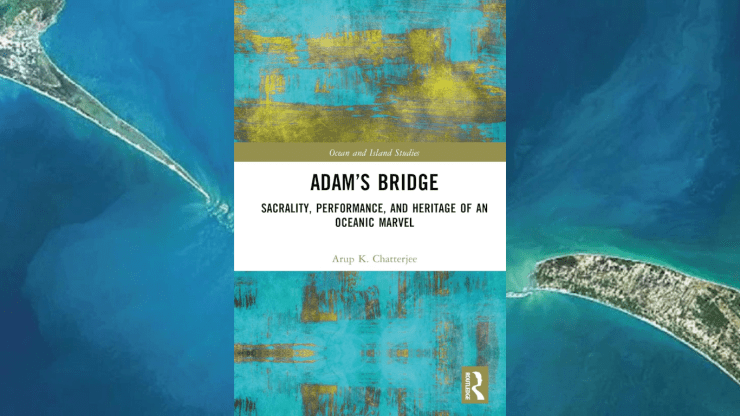
Adam’s Bridge: Sacrality, Performance, and Heritage of an Oceanic Marvel (Taylor and Francis/Routledge 2024)

‘Adam’s Bridge: Sacrality, Performance, and Heritage of an Oceanic Marvel is a fascinating contribution to study of space and spatial infrastructure as it braids environmental concerns, and sacred belief with discursive insights into the Anthropocene. It is the outcome of serious archival research and interpretive analysis.’
Professor (Dr) Lakshmi Subramanian
‘Arup K. Chatterjee tells a captivating story of a unique feature, spellbinding in its geology and symbolism—a sacred space; the work of Gods; an oft-neglected link that connects Tamil Nadu/India and Sri Lanka. For Hindus, it is a land bridge built by a monkey army so that God Rama could rescue his beloved Sita from the demon-king Ravana, in the kingdom of Lanka. For geographers, it is a unique terraqueous ecosystem with 103 tiny reefs and sandbanks, with islets appearing at low tide. For Muslims, it is the causeway that allowed Adam, the first Man, to leave the Garden of Eden (Lanka) and proceed to the Asian mainland. For historians, it was an unbroken causeway until breached by a fierce tropical storm in 1480; and the site of thriving port city of Dhanushkodi, until it was abandoned after yet another devastating storm that killed some 1,800 people in 1964. For Indian and Sri Lankan nationalists, it is the site of tension, as one suspicious side accuses the other of dubious motives for interest and investment. For the thousands of species who live there, it is home. An ocean marvel indeed, and more besides. With this book, Chatterjee walks us through the multiple representations of this unique formation, perched graciously yet perilously betwixt two countries, land and sea, sacral and temporal, calm and tumult.’
Professor (Dr) Godfrey Baldacchino


Arup K. Chatterjee’s Adam’s Bridge provides a scholarly socio-cultural insight into an enchanting geological feature called the Adam’s Bridge, a linear coralline ridge separating a shallow sea between Pamban Island on the southeast coast of India and Mannar Island on the northern coast of Sri Lanka. A part of the Hindu mythological lore celebrated as the mythical Rama’s bridge, it became a hot topic of discussion both among environmental scientists and among religious enthusiasts, ever since the government mooted the idea of dredging a navigable route through the limestone shoals of Ram Setu. This book takes us through a complex web of ethnography, historiography, and ecological equity concerning this oceanic structure. In this most profound and eloquently written work I have read on Adam’s Bridge (Ram Setu), the author enables us to think about ways of heritagization of this marvel of nature by fostering cross-cultural collaborative efforts. Indeed, a fascinating book and a must-read!
Professor (Dr) CP Rajendran
‘Considering the evolving geopolitics of southern South Asia, bridging the sea between India and Sri Lanka may perhaps soon get on policy radar screens. By delving into history, historiography, geology, ecology, politics, economics, mythology, and more, Arup K. Chatterjee provides a fascinating background to the physical structures and legend-based structuration of Adam’s Bridge that may very well shape South Asian futures in this century.’
Professor (Dr) Nikhilesh Dholakia


‘Arup K. Chatterjee has made a landmark contribution to South Asia’s coastal histories. Meticulously researched, this book is an epic, interrogative excavation of India’s Adam’s Bridge. Enchanting and exhaustive, it is a provocative inquiry into the intertwining legacies of colonialism, decoloniality, and island geologies.’
Professor (Dr) May Joseph
‘Adam’s Bridge: Sacrality, Performance and Heritage of an Oceanic Marvel is a fascinating study of the historiography of the eponymous structure (also known as Ram Setu), touching upon several entangled threads on myth, literature, colonial narrative, and contemporary politics. It empowers an understanding of how the idea of Adam’s Bridge/Ram Setu became infused with power over the minds of people. This dispassionate analysis reveals that much of the current controversy related to it is public theatre – a cognitive category the distinguished American anthropologist Clifford Geertz saw as a useful lens in interpreting the history and evolution of religious landscapes.’
Professor (Dr) Subhash Kak

‘Melting the boundaries between the sacral traditions of Ram Setu and geoscientific knowledge about Adam’s Bridge, Arup K. Chatterjee offers a fascinating account of the tombolo stretching from India to Sri Lanka. The story of origins, politics, diplomacy, ecology, and the troubling concerns of the Anthropocene, is pertinent to the current debates about dredging the area. What are the risks and gains to the people and the planet? How do ancient beliefs interface with modern commerce? Impressive scholarship and cultural sensitivity make Adam’s Bridge highly significant and wonderfully engaging.’
Professor (Dr) Malashri Lal
‘Arup K. Chatterjee’s latest book, Adam’s Bridge: Sacrality, Performance, and Heritage of an Oceanic Marvel (Routledge UK, 2024) is unique, as is the subject of this formidably complex and multilayered volume … a fine book-length revelation of Adam’s Bridge or Ram Setu as a magnificent and enchanting ‘tombolo’ whether seen from soteriological or geological perspectives! … Chatterjee recounts an intriguing saga, previously very little known, plausibly told through discourses traversing history, geology, mythology, legends, political, cultural, and geostrategic mores, in a most delightful way. Adam’s Bridge will inevitably stimulate further thought and pronouncements by those fascinated by the world’s natural and anthropogenic geography, its civilization, and its amazing place in our collective minds. I recommend this book to both academic and non-academic readers most enthusiastically!’
Richard Cathcart

‘Adam’s Bridge is a superb addition to the emerging discipline of oceanic and island studies. It presents an engrossing academic analysis of the social, economic, and cultural heritage surrounding the structure in the Gulf of Manner to pick apart a region’s multifaceted historiography.’
The Telegraph, India
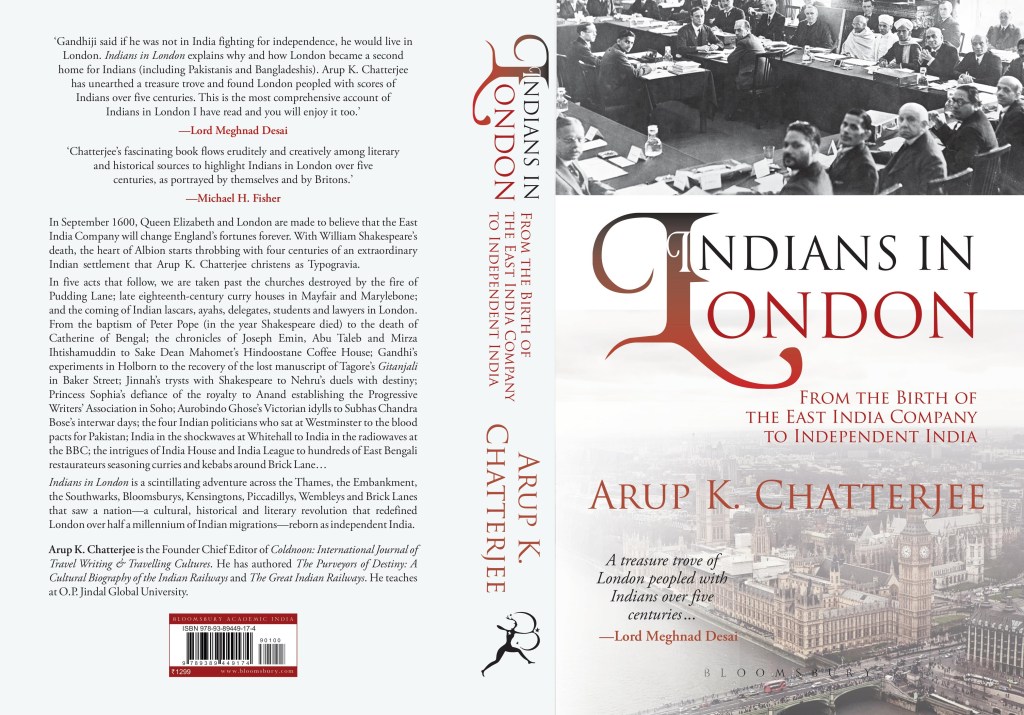
Indians in London: From the Birth of the East India Company to Independent India (Bloomsbury 2021)
‘It’s a rare book which may be described unequivocally as an absolute and utter delight. This is one of them. Arup K. Chatterjee’s Indians in London is an erudite, well-researched and comprehensive survey of a fascinating subject—four hundred years of Indian residency in London, beginning in 1600. This was the date that the East India Company was founded, but also the year when Shakespeare’s As You Like It was entered in the Stationer’s Register.
‘The latter is as important for this book as the former; Chatterjee imaginatively uses the five-act structure of an Elizabethan play as his framework in lieu of chapter headings, showing how people from the Indian subcontinent (Chatterjee includes those who would now be Pakistanis and Bangladeshis in his book) progressed from being a few exotic foreigners in Act I to members of a significant part of the beating heart of modern cosmopolitan London. There are entrepreneurs, politicians, lawyers, students, nursemaids, poets, novelists, the inevitable restaurateurs and even the odd princess, not to mention a sprinkling of dubious characters as well in this play, with a cast of thousands all playing their parts in the still-unfolding drama. Famous names abound, too; at one time Gandhi, Rabindranath Tagore, Subhas Chandra Bose, Princess Sophia Duleep Singh, Swami Vivekananda, Jiddu Krishnamurti, Mohammed Ali Jinnah and Jawaharlal Nehru, to name but a few, all lived in London and made their marks there. You can even find out exactly where all these people and many others lived in London by consulting the helpful map and its key (list of names) at the beginning of the book.
‘The scope of characters discussed in Chatterjee’s book is monumentally wide (as is the massive bibliography); a reviewer must be restricted to mentioning those parts which are personally interesting. There is, in fact, a character for every taste from food to politics in this book. A great deal of space is devoted to food and restaurants, which are, after all, perhaps the two aspects of Indian culture best known to foreigners. In London alone there must be at least a thousand or more Indian restaurants after allowing for Covid- and Brexit-induced closures; even in Winnipeg, where I live, there are still at least thirty … Chatterjee gives us so much detail and presents so many fascinating characters from this period that it’s impossible to sum it all up in a review; suffice it to say here that readers become immersed in the teeming cast of thousands in this play, which reads is more like a Hollywood epic (with lots of extras) than a Shakespeare play with a few characters! … Chatterjee’s exciting book is a triumph of scholarship and a wide-ranging adventure leading us to come to a greater understanding of the evolution of one of the world’s most historically cosmopolitan cities.’
(John Butler, former Associate Professor of Humanities at the University College of the North in The Pas, Manitoba, Canada; in the Asian Review of Books)

‘Indians in London explains why and how London became a second home for Indians (including Pakistanis and Bangladeshis). Arup K. Chatterjee has unearthed a treasure trove and found London peopled with scores of Indians over five centuries. This is the most comprehensive account of Indians in London I have read and you will enjoy it too.’
Lord Meghnad Desai
‘Arup K. Chatterjee’s fascinating book flows eruditely and creatively to highlight Indians in London over five centuries … A scintillating book … [on] diverse Indians of all classes [who] were not necessarily always acted upon, but had their own agency, their own attitudes, and their own actions. The book extends Indian history to Britain, greatly adding to works that provincialize Europe.’
Michael H. Fisher

‘A fascinating book, written with immediacy … but without a voyeuristic intimacy. [Arup-babu] has tried to unravel stories, without sensationalizing them, with sympathy and respect for [his characters] even when he is lethally critical of them …There is no slant in it. It has the royalty, the subalterns, the rich, and absolutely down-and-outers … It has Indians in all their varieties, all their contradictions, all their contrasts, conflicted as they are … but Indians [nevertheless] …’
Gopal Krishna Gandhi
‘A remarkable achievement of 500 pages, packed with gems, remarkable memories wonderful vignettes, terrific anecdotes, drawn so widely, both historically and in terms of themes … [that] become a brook, a stream and a veritable tributary … a very timely book, given the prominence of Indians in British society today … Indians in London adds texture to the colonial relationship between Britain and India, by unravelling the complexity of its various strands, particularly through intimate descriptions of individuals that lie below.’
Paul Flather

‘A delightful work that covers a vast amount of ground in its 500 pages, full of detailed research, which wears its erudition … [nonetheless] amazingly readable.’
Shashi Tharoor
‘There is a rich history of the migration, both short- and long-term, of Indians to London from at least the early seventeenth century … Arup K. Chatterjee’s new book … opens up this rich, varied history and aims to reach a wide audience … a comprehensive overview of the key figures and groups who populated the city from the early seventeenth century until 1947 … in a new format and furnished with an interesting literary style that will fascinate international audiences of general readers.’
Sumita Mukherjee, in The English Historical Review


‘Indians in London is a riveting narrative that investigates the lives and experiences of numerous Indians who visited, stayed, and left their mark in the imperial capital of London from around the time of Shakespeare to Indian independence in 1947 … Chatterjee has divided the book into five acts and scenes by replicating the structure of a Shakespearean play, through which he reveals the Indian psyche that clung to the idea of London.’
Md Sarfaraj Nawab in The European Legacy
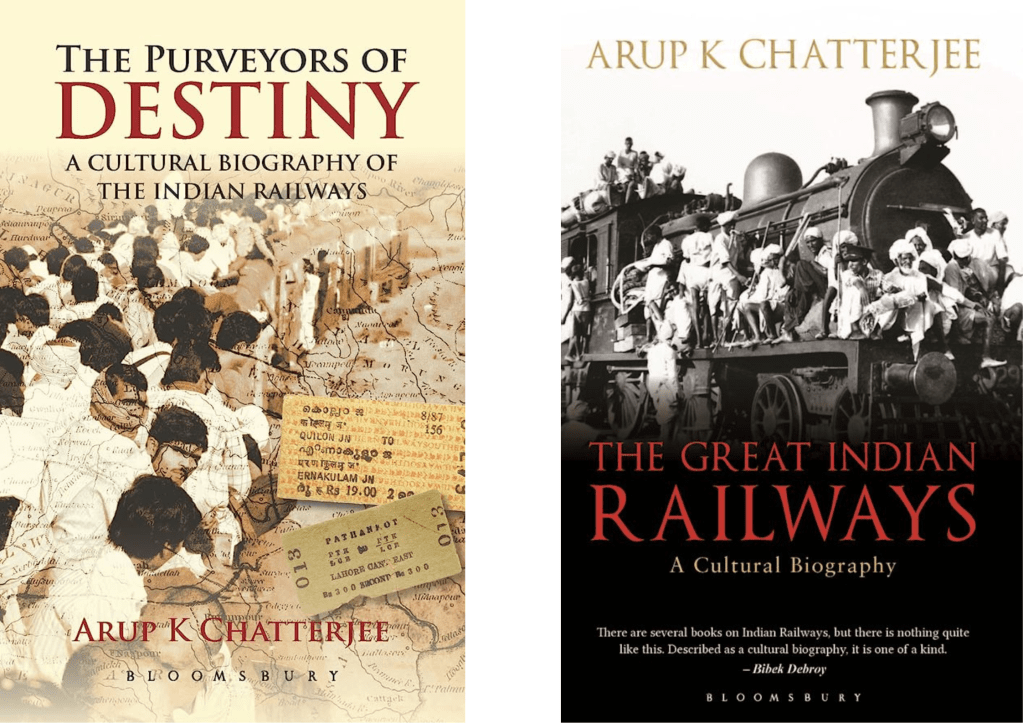
The Great Indian Railways: A Cultural Biography (Bloomsbury 2018) and The Purveyors of Destiny: A Cultural Biography of the Indian Railways (Bloomsbury 2017).
Dozens of books have been written about Indian rail, but perhaps only Arup K Chatterjee’s The Great Indian Railways captures the wonder of a behemoth made of 42,226 miles of track, 108,000 daily services to 7,325 stations and 1.2 million employees.’
Chris Haslam, The Times (United Kingdom)
‘[The Purveyors of Destiny] is a rare and unique perspective on the cultural history of an organization as perceived by writers, critics, films, colonial rulers and local citizenry from the 1840s till today … The most powerful chapter is the one on Partition, where the Railways become the ‘Dumb Waiters’ and purveyors of destiny of two nations. The horrors of Partition generated a large number of books, short stories and films, reminding us of the bestiality and violence on a scale rarely seen in history, while the national leadership looked on helplessly. Here, the author draws from Khushwant Singh’s Train to Pakistan, Krishan Chander’s Peshawar Express, a story where the train itself is the narrator of events that took place on it, Bhisham Sahni’s Amritsar Aa Gaya, Sadat Hasan Manto’s Kasri Nafisi and many more … Arup K. Chatterjee vividly captures the debates about its impact and on its changing cultural influence over time…Chatterjee is a professor of English; his command over language and facility with it, apart from his unique perspective on the railways, makes this exceptional book compulsive reading.’
Vinoo Mathur, Outlook India
‘Arup K. Chatterjee’s book, The Great Indian Railways, is not just about Indian Railways. It is about how the railways are deeply embedded in the psyche of the Indian mind and how railway premises in India are a reflection of the society. Among the several books presently on the subject in India, some on history, some specialised, statistical, anecdotal, archival documentation or simply photographic, this book, now into its second edition, fills up the vacuum of railways’ cultural contribution to the society by comprehensively chronologically documenting how the railways, as the author puts it “with or without our knowing, have come to define manifold aspects of Indian culture.”
‘And it begins with a perfect example on how one of the author’s grandfathers as someone originally from Benares — although a Bengali — used to keep his homesickness away, simply by visiting the railway station. “During his lunch hour, each day, he would visit Howrah Station and wait for the train from Benares, if only to catch of a glimpse of the people arriving from his hometown and return with a spring in his step.”
‘Starting chronologically from 1843 to the 1990s, the six chapters, with the prologue and introduction, take one on a kaleidoscopic journey of literature, life, reel and real stories, also weaving in numerous events as India moved from the times of the East India Company to the world wars, its fight for independence and from Lal Bahadur Shastri to Dr E Sreedharan. While on this journey, the author writes of people and nuggets of history, including the genesis of tea and railways, the association of Wheeler and Higginbotham’s book stalls and the railway catering controversy of the 1950s.
‘When I say the book takes us on a kaleidoscopic journey of literature and films, it includes not just fiction, but major works from the era as the chapters move ahead, right from various archival railway accounts by early planners, travelogues to the slices of fictional train journeys in popular works of Arthur Conan Doyle, Jules Verne and RK Narayan and even Shah Rukh Khan. The mention of the travels of Sherlock Holmes on those old-English teakwood trains pulled by steam puffing engines, to the quaint Malgudi station that gives us a sense of isolation, and numerous little railway plots in Bollywood and Hollywood — all take the narrative ahead.’‘
Rajendra Aklekar, Mid Day

‘In this fascinating cultural history, Arup K Chatterjee charts the extraordinary journey of the Indian Railways, from the laying of the very first sleeper to the first post-Independence bogey. It evokes our collective accumulation of those innumerable memories of platform chai and rail-gaadi stories, bringing alive through myriad voices and tales the biography of one of India’s defining public institutions.’
Shashi Tharoor
‘The Purveyors of Destiny is a fascinating and well-researched cultural biography of the Indian Railways-those intricate arteries of the soul of India, as have been experienced, written, filmed, and dreamed. We cannot all travel by rail to know India, as Gandhiji did, but we can and should read this book.’
Tabish Khair
‘Drawing on an impressive repertoire of literature and film, this elegantly crafted biography of the railways takes us on a riveting journey through the cultural history of the Indian nation, from the 1850s to the present. Written with wit and verve, it is a delight to read.’
Sugata Bose
‘There are several books on Indian Railways, but there is nothing quite like this. Described as a cultural biography, it is one of a kind.’
Bibek Debroy

‘A deeply engaging work that comfortably straddles, and masters, the worlds of academic research and modern nonfiction, offering countless delightful gems of India’s railway legends and narratives for the curious reader. Crafted with great skill and a keen understanding of modern culture from the region and beyond…a remarkable achievement!’
Kaushik Barua
‘A wonderfully eclectic account of the Indian Railways and the vital place they occupy in our cultural history, with memorable moments and motifs from literature, cinema and other elements of our collective imagination. A great train journey, replete with all of the essentials from garam chai and A.H. Wheeler to historic arrivals and departures …’
Stephen Alter

Arup K Chatterjee has done a stellar job in documenting railway history as an expert sutradhâr, mixing both non-fiction and poetry skills with great effect … The Great Indian Railways is extremely well researched, its stories enthusiastically told, where “journeying and journalling” coalesce elegantly in an informative and fascinating journey.’
Sudeep Sen, Asian Age
‘The Great Indian Railways, is not just about Indian Railways. It is about how the railways are deeply embedded in the psyche of the Indian mind and how railway premises in India are a reflection of the society … this book, now into its second edition, fills up the vacuum of railways’ cultural contribution to the society by comprehensively chronologically documenting how the railways, as the author puts it “with or without our knowing, have come to define manifold aspects of Indian culture.“‘
Rajendra Aklekar, Mid Day
‘Chatterjee’s courage in undertaking such a vast endeavour is laudable … the book is thoroughly enjoyable, even if it is just for its rich trivia.’
For [Chatterjee], the railways is not just an actually existing entity, but is, rather, a myth of tremendously Indian proportions, invoked and evoked in all forms of the national and popular imagination …This book attempts not just to create a new genre, but to set down new tracks for thought, method and writing in the area of culture studies …The perspective Chatterjee brings to this subject is a new and courageous one: rather than drafting a catalogue of novels, films, diaries and journals that have the railways as their theme, which would be expected in such a work, he investigates how the railways themselves affect the form and content of their own representations … The greatest achievement of this book is that it gathers and collects the myths, narratives and histories of the Indian Railways from sources as disparate as colonial archives and popular movies. Chatterjee successfully conjures up the magic in a lucid style, while maintaining the gravity and solemn tone reminiscent of a train journey
Huzaifa Omair Siddiqi, Scroll
‘Arup K. Chatterjee in his The Purveyors of Destiny: A Cultural Biography of the Indian Railways traces the 156-year-history of the Indian Railways from an unusual angle—how the railways influenced the cultural milieu of India through not only literature, films and songs, but also catalyzed revolutionary changes in the country’s political and social canvas. It was the beginning of a new India after the first passenger train ran in Bombay on August 15, 1853. Railways are yet to reach all nooks and corners of India. The changes therefore are continuing.’
Gautam Gupta, The Hindu
‘Arup K. Chatterjee is the prime engine driver in these trains of thought, and the purpose of this wonderful book, is to introduce the reader to the ever expanding archive of representation (a train whistle here would be most appropriate) of the Indian railways. As the son of a loyal PWI or Permanent Way Inspector of the Central Railway of India, let me line-clear at the outset with the author’s own insistence of that cute train song from Sholay ‘station se gadi jab chhoot jaati hai to, ek do teen ho jati hai’. Like these nau do gyaara lines, the book signifies in tantalizing numerical order vitality, progress, and the delightful critical prospect of decoding all those epiphanies brought to light that in many ways open up for me, all over again, my own private operatic love affair with the Indian railways … Chatterjee’s “second great rendezvous with the railways” that comes with the samaan of Arthur Conan Doyle’s The Hound of the Baskervilles. Mine came with my first reading of A Study in Scarlet in Bombay-Poona’s original Deccan Queen’s first class compartment which was a sealed coupe with polished wooden walls, a freshly cleaned carpet, and ornate reading lamps. This Sherlock Holmes story, like Chatterjee’s: was an abridged and illustrated version of the novel and was presented to me as “a boon for I could read about and see how a first class carriage looked” since I was in one that exactly resembled the kind Watson and Holmes often took in their railway journeys from Baker Street to the hinter lands of England … it is important to spend some time focusing on the author’s resurrected examples of those “representations” in Indian cinema and Indian literature, especially for those Indians who tend to be stubbornly and even foolishly stranded in galaxies so far far away from the conspicuous Indian terrain that so memorably coaxed and guided Chatterjee’s generation and mine, flanked as we were by those two proverbial railway track lines, permanently on either side of us … Chatterjee [also] offers us superb insightful readings of Ray’s signified train moments. The train enters the chamatkara mental landscape of Apu in Pather Panchali as he runs with his sister Durga in an explosive field of kaash flowers. “This tingling encounter with a train belching black smoke” is one that none of our five senses can ever forget. Then, in Aparajito, there is another train that takes away Apu’s family to Benaras from their ancestral village. But there, as the author notes, the train further estranges Apu from his mother when she goes back to her village and he embarks on his future in the distant city of Calcutta … It is in Nayak, however, that Ray really makes, as Chatterjee so brilliantly enunciates, “the luxury train function as the site of so many perpetuating desires“ that “transmute from the interiors of first class cabins, to the restaurant car” where the baring of souls is wonderfully achieved between an arrogant film star progressively humbled, both by the train’s steady rhythmic motions and the good faith permeations of an honest female interrogator. [Then] Rudyard Kipling becomes the prime literary signifier of Indian Railways for Chatterjee and very correctly does he commence on Kipling’s “tyrannical Te-rains” with an interesting reading of all the train references in Kipling’s great novel, Kim. There is the characteristic idea of “the supposed solidarity of the characters” that joins friends and unites the anxious in “this thing,” the “te-rain,” which as the burly Sikh artisan reassures the lama and Kim “is the work of the Government.” This spurs the academic in Chatterjee to educate us about the idea of “governmentality” as deployed by Michel Foucault from his college de France lectures delivered between 1978 and 1979. Chatterjee portmanteaus skillfully between the government’s “power” (Foucault’s singular historical idea and predominant critical utterance) and its creations of certain “mentalities” that visibly and ideologically affected “territories, communication and speed” that were first brilliantly cited by Kipling and later by Indian authors like Sa’adat Hasan Manto. Chatterjee offers scintillating readings of how Kipling, in his story “The Bridge Builders” reaffirms the “myth that the world of Eastern mystical legends co-exists facilitating the osmosis of social, scientific and even metaphysical reason aboard the railways.” But then he slyly deconstructs this idea by showing how Flora Annie Steel’s “In the Permanent Way” short story derails Kipling’s myth as being a hollow one by allowing “a whole train to go over an English railway engineer and an Indian Hindu saint who are so locked in each other’s arms” that it was hard to separate or even distinguish which was Shriver’s Martha Davy and which was Wishinyou Lucksone, semantically, historically, or culturally … Looking at these ugly Diesel locomotives pulling all the Indian trains today, one nostalgically longs for “the black beauties” (as those great W.P and W.G. steam engines were once called.) Since their “iron flesh” was stripped of “all their embellishments,” what we are left with today is an ugly skeleton network of what was once, undeniably, a great Indian Railway. Thank you Arup Chatterjee for at least resurrecting its ghost in all the right Proustian ways in today’s conspicuous Bharatian world of appalling mediocrity.’
Darius Cooper, The Beacon
 Arup K. Chatterjee