
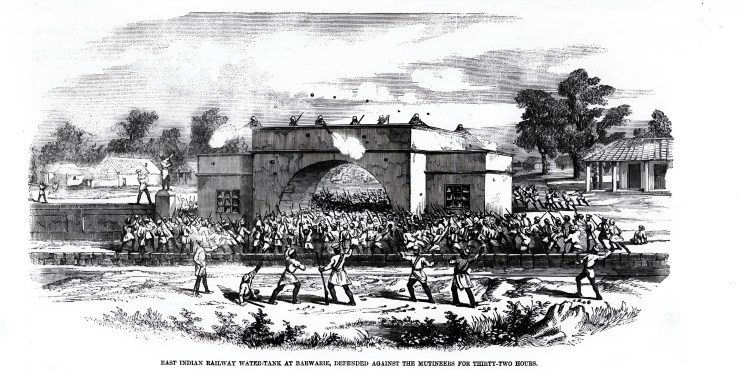
The above image anchoring an article by T. J. Ryves, from first issue of The Illustrated London News of 1858, presents a wonderful and gruesome paradox—the bastion of a passenger railway service in India, built by the British, being defended against the very passengers that the British Empire hoped to have as its clientele.
The connection between the First War of Independence (1857) and the Indian Railways was paradoxical, and therefore deeply revealing. The railways did not merely suffer from the upheaval of 1857, even though they certainly did. The railways were also remade by it, in ways that tied commerce, transport, and empire more tightly together than before. As The Great Indian Railways: A Cultural Biography (2018) informs, the East Indian Railway Company incurred immediate losses of forty-two thousand pounds sterling during the conflict of 1857, a figure that reminds us how vulnerable the network and its servants were in the face of violent rupture. The railway’s stations, tanks, bungalows, and personnel became exposed sites of imperial life. In that sense, the railway was not an abstract symbol of progress, but a material target within the struggle itself. The rebellion entered railway history not as a footnote, but as an event that tested the very claims of modern connectivity.
The article by Ryves, from The Illustrated London News, is especially valuable because it shows railways in the condition of siege rather than triumph. The water tank at Barwarie becomes, for fifty two hours, a defensive outpost. Railway-men, women, and children shelter atop it while surrounding crowds loot, burn, and demand conversion. The image is stark, and its significance is more than anecdotal. A piece of transport infrastructure becomes a fortification because the normal channels of colonial order have broken down. This is a remarkable inversion. The railway, so often advertised as a technology of movement, appears here as a means of immobility and survival. It binds bodies together under threat, and it also reveals how thin the line was between infrastructure and vulnerability.
W.J. MacPherson’s economic history of the Indian Railways (1955) explains why the rebellion altered railway policy so decisively. Lord Dalhousie’s programme of expansion and annexation had already linked railways with imperial consolidation, but 1857 gave that logic a new urgency. The Sikh wars had shown the disadvantages of poor communication, yet the year of 1857 made the lesson unavoidable. More miles were added in 1858 and 1859 than in the whole period before, not because the railways had suddenly become more profitable, but because it had become more necessary to state power. Railways were now defended as instruments of military economy, since improved efficiency might reduce the heavy costs of the army. MacPherson observed that military expenditure in 1856 to 1857 formed a large portion of government outlay, and that savings on army costs were expected to offset guaranteed interest deficits. In other words, the railways became part of a fiscal and strategic policy at once.
The new imperial ideology also changed the moral imagination of railway-building. Before 1857, railways could still be presented as acts of civil improvement, instruments of social literacy, commercial progress, and administrative reform. After 1857, they came to be understood more explicitly as arteries of control. Trunk lines became more valuable not only for trade, but for defence from external aggression and, by implication, internal disorder. The ‘Mutiny’ intensified the imperial reading of railway spaces. Tracks were no longer only routes across a vast territory. They were also lines of rapid response, corridors of troop movement, and guarantees against future insurrection. This was a profound transformation, and it shaped the next phase of railway expansions in India.
Yet it would be too simple to say that the railways were merely an instrument of repression. The same crisis that exposed their fragility also demonstrated their indispensability. Railway workers, engineers, and families were caught in the violence as civilians of empire, and their experiences fed a narrative of heroic endurance. At the same time, the rebellion made the government invest more heavily in the system, thereby accelerating the spread of rails across the subcontinent. The First War of Independence stands in railway history as both interruption and catalyst. It damaged the railway network and delayed expansions by several decades, but it also deepened the strategic value of the railways. The result was a more militarized railway order, one that would shape colonial India for nearly a century later.
Following is the article by Ryves as an attestation to the above.
AN INDIAN RAILWAY STATION DEFENDED
(From a Correspondent at Allahabad)
I send you a sketch of a Railway Water-tank at Barwarie, twenty-three miles from Allahabad. The village in the distance is Barwarie. The dimensions of the tank were about 16 feet high, 22 feet long, 24 feet broad, and depth of tank 4 feet.
On Sunday, the 7th June, 1857, at noon, the day after the massacre at Allahabad, P. O. Snow, railway engineer, Mr. J. Rose, Mr. Mathers, Mr. Leithbridge, wife and child, Mr. J. Keymer, wife and three children, Mr. R. Keymer, all employed on the railway, and Major and Mrs. Ryves, were assembled at the latter’s bungalow at Barwarie, when information was brought that Mr. Lancaster, an inspector, had been murdered, a mile off, when trying to join the above party. Immediately on receiving this news Mr. Ryves and the women and children were assisted up to the top of the tank, we men intending to come down again for provisions, &c.; but, as an immense number of armed natives began to assemble, it was deemed more prudent to remain where we were, else we might have been cut off.
The natives commenced to loot, and destroy the furniture, &c., in the small bungalow (shown in the sketch) belonging to the railway contractors, Messrs. Norris and Co., which having completed, they went in a mass to my bungalow (about 100 yards in front of the tank), where they began to loot everything I was possessed of, even to taking off doors and windows, and breaking to pieces what they could not take away. Having completed this work of destruction they set fire to the bungalow, outhouses, and everything that would burn. Then, shouting and yelling, they rushed over and surrounded the tank by hundreds, throwing brickbats and stones at us. We kept them off with our guns. The top of the tank had no cover; and the women and children had to be protected by a mattress, which they sat under to prevent being killed by these missiles. The cowardly rascals kept this up constantly (several of us had severe contusions), at the same time demanding money, which we threw them. When they found we had no more left, having expended 3000 rupees, they wanted us to come down. We refused to do so. They then brought straw and other inflammable matter, and piled it round the tank, and set fire to it, which caused a great suffering from the smoke and heat, but, the tank being of brick, it sustained no damage. Finding all their exertions to make us yield had failed, they said they would spare our lives if we all turned Mahometans. This, of course, one and all refused to accede to; a party was dispatched, saying they were going to muster a large armed force to escalade our stronghold during the night; we told them we were prepared to sell our lives in protecting the women and children. We were thus exposed (14 of us) with no covering from the fearful heat of the sun, very little water to drink, and only parched grain and boiled rice to eat for 52 hours; and had to defend our post against a mob of 3000.
On the morning of the 8th Mr. Smyth, an inspector, joined our party, very severely wounded, having had to run for his life, accompanied by Inspector Thomas, who was murdered that morning when on their way to join us. We pulled Mr. Smyth up to the top of the tank with ropes. This increased our party to 15. He was too weak from wounds to be of any assistance.
Having succeeded in getting a servant to take a note to the commanding officer at the fort of Allahabad, telling him of our position, a relief of 35 Irregular Cavalry were sent out to us, and arrived at 4 p.m. on the 9th. Glad we were to see them, and a hearty cheer we gave them, inwardly returning thanks to God for this succour, as we should have had to fight hard for our lives that night. The distress of the poor women and children (without any conveniences) can hardly be supposed except by those who have experienced the heat of an Indian sun in the month of June. Mrs. Ryves was killed by its effects. She died in an hour after the relief had arrived, thus adding another victim to the long list of deaths occasioned by this awful rebellion.
The villagers, headed by the zemindars, were the people who looted, destroyed, and burnt all the railway gentlemen’s bungalows on the line.
T. J. RYVES
References
Chatterjee, A. K. (2019). The Great Indian Railways: A cultural biography. Bloomsbury Publishing.
Macpherson, W. J. (1955). Investment in Indian railways, 1845–1875. The Economic History Review, 8(2), 177–186.
Ryves, T. J. (1858, January 2). An Indian railway station defended. The Illustrated London News, p. 5.
 Arup K. Chatterjee