
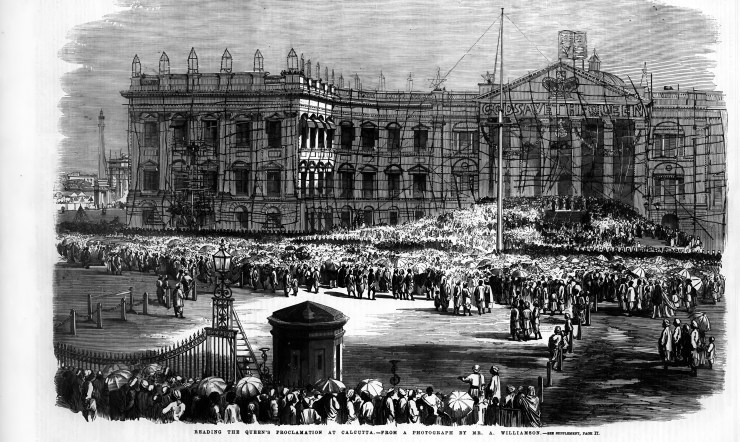
The above engraving, based on a photograph by A. Williamson, published by The Illustrated London News, on January 1, 1859, captures a moment of imperial self-declaration that intended to be once solemn and theatrical, after a year of monumental unease.
It shows the public reading of Queen Victoria’s Proclamation in Calcutta’s Town Hall, in November 1878, an event that announced the transfer of authority from the East India Company to the British Crown after the catastrophe of 1857. The message was plain enough, even before the proclamation was read. Empire had survived rebellion, and wanted to present itself as benevolent and permanent.
The Town Hall, built in Roman-Doric style in 1813, Major General John Henry Garstin, itself was staged as a kind of civic temple. Its long façade, Doric pillars, high windows, and strong symmetry give it the air of an official palace. The decorative scaffolding and the festoons signified celebration and, strangely enough, repair, at once; for power to be made visible in order to be believed. One notices the large inscription on the front, proclaiming loyalty to the sovereign, and the roofline carries the kind of bannered verticality that turns architecture into a political emblem. The scene is crowded with formal embellishment. It has the heavy grandeur of an administration anxious to appear reassuring. The building seems to say that after the turbulence of the uprising of 1857, the British government will now be grandiose, public, central, and monumental.
The crowd is the most striking feature of all. It is a dense multitude gathered across the open ground. Men in turbans, robes, coats, and caps stand shoulder to shoulder with umbrellas opened against the weather or the glare, producing a pattern of circles across the white space of the courtyard. The umbrellas create a sea of little canopies beneath the great ceremonial canopy at the building’s front, amid the crowd’s disciplined concentration upon the act of the queen’s proclamation. There is no panic in the scene, no movement of alarm, but regimentation, waiting, listening, and the plain fact of assembled bodies. The image clearly recorded the performance of authority while also displaying the governed population as witness.
Meanwhile, the reading of the proclamation was carefully constructed to announce rupture while disguising rupture as continuity. Queen Victoria declared that the territories in India were taken under her own government, formerly administered in trust by the Company. It implied that Company rule had always been provisional, a stewardship now recalled to its rightful sovereign. Charles John, Viscount Canning, was appointed the first Viceroy and Governor-General, and the proclamation confirmed existing civil and military officers in their posts, calming fears of administrative dislocation. It announced respect for treaties with native princes, disavowed territorial expansion, and promised that imperial power would not encroach on the rights of others. Yet the proclamation was a document of victory, announcing that the British had prevailed. The Queen lamented the misery brought by “ambitious men” who misled their countrymen, and she spoke of the rebellion in terms that separated the deceived from the guilty. Her promise of amnesty rested upon the assertion that rebellion was criminal and that British arms had suppressed it in the field. Mercy was extended to the “rebels” only after the sovereign had drawn a hard line around the limits of forgiveness. The Crown appeared magnanimous while preserving the moral asymmetry between ruler and ruled.
The image and the proclamation of November 1858 together tell us how British authority wished to be remembered in India after 1857. The architecture, the flag, the ceremonial draping, and the dense choreography of bodies reinforced hierarchy and consent towards imperialism. The image was born of the need for the visibility of imperial power after the War of Independence, at a time when the British Empire was more self-conscious, though perhaps more anxious than before. This imperial scene, made legible to readers in London, announced the Empire’s moral recovery in a political drama of repair.
Reference
Reading the queen’s proclamation at Calcutta. (1859, January 1). The Illustrated London News, p. 8.
 Arup K. Chatterjee